When and why to use it
Use it every time cooked food is cooled for later use, for example stocks, sauces, rice, cooked meat and batch-cooked dishes. Large pots and deep containers need the closest watch, because they cool slowest.
Cooked food that cools too slowly gives spore-forming bacteria time to grow. This free food cooling log is for restaurants, caterers, food trucks and small kitchens that cook food in advance and chill it for later. The top of the sheet holds the cooling limit from your HACCP plan and the thermometer number. Each row follows one batch from the end of cooking: the food and batch, the amount, the cooling method, the start time and temperature, one check reading, the end time and temperature, whether it met your limit, the corrective action and who checked it.
In EZLineGo, cleaning, temperatures, deliveries, health records and training are in one place, and at an inspection you show them as a PDF.

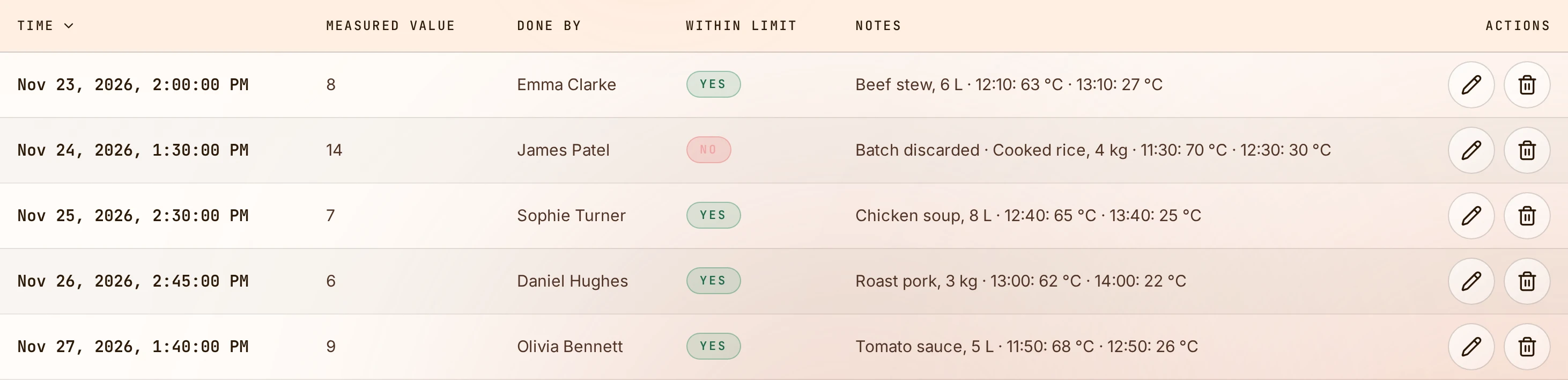
A business can create its own HACCP plan with the cooling control point and a critical limit, then log each batch with time, person, final core temperature, within-limit result, corrective action and notes.
Use it every time cooked food is cooled for later use, for example stocks, sauces, rice, cooked meat and batch-cooked dishes. Large pots and deep containers need the closest watch, because they cool slowest.
Scope: food businesses in the EU and Great Britain, with a note for the US. Regulation (EC) No 852/2004, Annex II, Chapter IX, point 6, requires food held at chilled temperatures to be cooled as quickly as possible after heat processing to a temperature that does not result in a risk to health; your HACCP plan sets the limits. In England, Schedule 4 of the Food Safety and Hygiene (England) Regulations 2013 sets 8 °C as the general chill holding limit. In the US, FDA Food Code 3-501.14 requires cooling from 57 °C (135 °F) to 21 °C (70 °F) within 2 hours and to 5 °C (41 °F) or less within a total of 6 hours.
EUR-Lex: Regulation (EC) No 852/2004 on the hygiene of foodstuffs · legislation.gov.uk: Food Safety and Hygiene (England) Regulations 2013, Schedule 4 · FDA: Food Code 2022 · 2026-11-26
Use the cooling times and temperatures in your own HACCP plan. Write each real reading at the time it is taken, not afterwards.
A restaurant’s plan sets the Cooling limit as below 21 °C within 2 hours and 5 °C or less within 6 hours. On 10 March 2026 the cook writes: Food, batch: beef stock B-0310; Amount: 12 l; Cooling method: four shallow 3 l containers in the blast chiller; Start time 14:10, Start °C 90; Check time 15:55, Check °C 18; End time 18:30, End °C 4; OK Y; Checked by KB. A second row the same day: rice, 6 kg, Cooling method: tray on the bench; Start time 12:00, 88 °C; Check time 14:00, 34 °C. The limit is missed, so OK N and Corrective action: discarded 14:05, rice now cooled in the blast chiller only.
The ones in your own HACCP plan, based on the rules that apply to you. The figures on this page explain the regulations; they are not a validated process for your food.
You can create your own plan with the cooling control point and critical limit, then save each batch with time, person, final core temperature, within-limit result, corrective action and notes.
No. The PDF and the editable file are free without registration. Saving records in the app requires an account and Pro access or an eligible 30-day Pro trial; no card is required for the trial.
As long as your HACCP plan and the rules in your country require. Regulation (EC) No 852/2004, Article 5, requires documents and records that fit the nature and size of the business.
The templates help you keep records. They do not replace your own HACCP plan.