A food production record ties each batch you make to its ingredients, its checks and its date. This free food production record template is for central kitchens, caterers, bakeries, delis and restaurants that cook in batches for later service or sale. The top holds the core temperature limit from your HACCP plan and the thermometer number. Each row records the date, the product or recipe, the batch code, the planned and the made quantity, the ingredient lot numbers, the allergens, when it was cooked, the core temperature and whether it is OK, the use-by date, what was left over and who made it.
When and why to use it
Use it every day that food is produced in batches for later use or sale, such as sauces, soups, pastries, sandwiches for a counter or meals for an event. It is most useful when more than one person cooks or when products go to other businesses.
Practical guidance
No regulation prescribes this form. It supports two duties: Regulation (EC) No 852/2004, Article 5, requires records that show your HACCP checks work, and Regulation (EC) No 178/2002, Article 18, requires you to know your suppliers and the businesses you supply. Recording ingredient lots per batch goes beyond Article 18 but makes it faster to find affected batches in a recall. Give each batch a code that also goes on its label, and keep the planned and actual quantity apart so you can compare production with sales and waste.
EUR-Lex: Regulation (EC) No 852/2004 on the hygiene of foodstuffs · EUR-Lex: Regulation (EC) No 178/2002, general food law · 2026-11-26
Write each batch when it is made. A production record filled in from memory at the end of the week cannot support a recall or a shelf-life decision.
How to fill it in, in 5 steps
- 1Fill in Business name, Location, Year, month, the Core temperature limit from your HACCP plan and the Thermometer no.
- 2Before you start, write Date, Product, recipe, a new Batch code and the Planned quantity in portions or kg.
- 3While you produce, write the Ingredient lot numbers of the main ingredients and the Allergens the batch contains.
- 4After cooking, write Cooked at (time), probe the thickest part and write Core °C and OK (Y/N); then the Made quantity and the Use-by date from your plan, and put the batch code on the label.
- 5At the end of service, write what was Left over and sign Made by.
How it works day to day
- 1Before production, write the date, the product and the planned quantity.
- 2While producing, write the ingredient lots used and the cooking or core temperature check.
- 3After production, write the actual quantity, the batch code and the use-by date, and put the same code on the label.
- 4Sign the row; compare the week’s production with sales and waste.
Worked example
A caterer’s plan sets the Core temperature limit at 75 °C. On 10 March 2026 the cook writes: Product, recipe: chicken curry, recipe 12; Batch code CC-0310-1; Planned 80 portions; Ingredient lot numbers: chicken L4471, coconut milk 2603B, rice R-0218; Allergens: celery (in the stock); Cooked at 10:40; Core °C 82; OK Y; Made 78 portions; Use-by date 12 March 2026, chilled; Left over 9 portions, cooled and logged in the cooling log; Made by KB. Next week the planned quantity drops to 70 portions, because 9 were left over twice.
Common mistakes
- Using the same batch code for two days of production.
- Writing the planned quantity in place of the actual one.
- Leaving out ingredient lots for products that go to other businesses.
- Setting a use-by date without a basis in your HACCP plan.
Is this the same as a cooking temperature log?
No. A cooking log records one check. A production record ties the whole batch together: quantity, ingredients, checks, label code and date.
What does EZLineGo record for production?
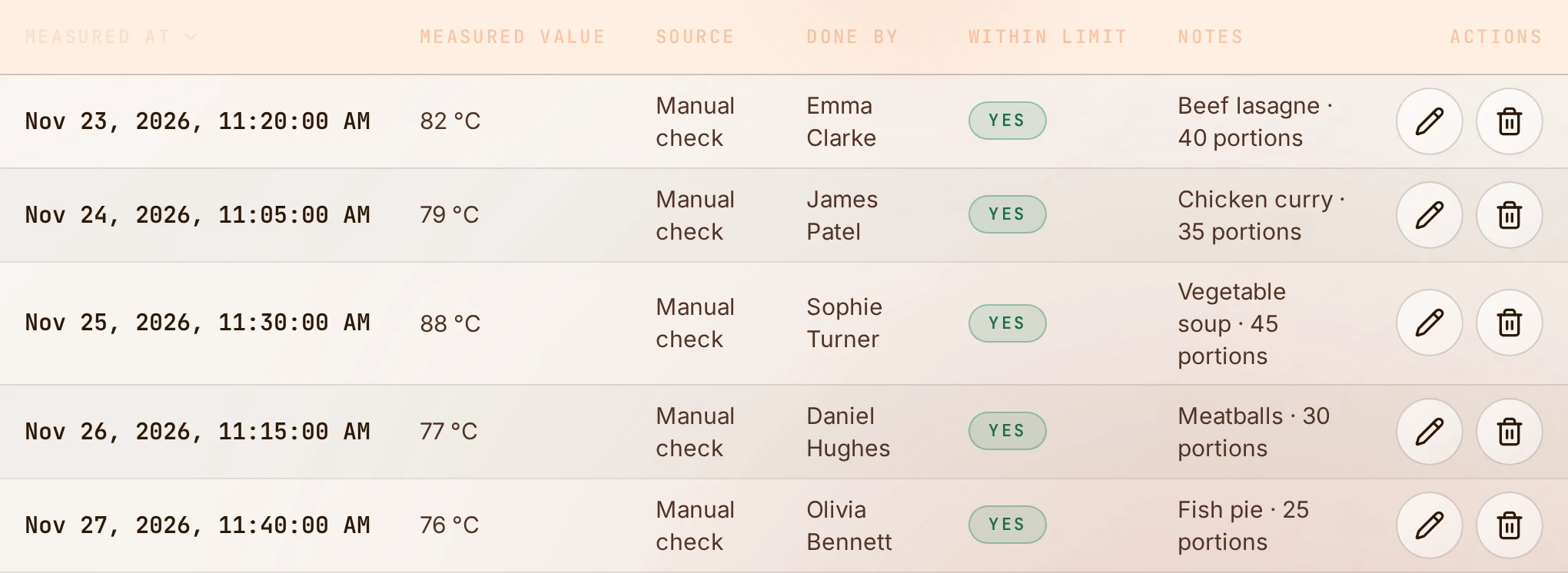
The cooking temperature log saves each batch with time, person, core temperature, within-limit result and a note for the dish and quantity.
Do I need an account for the blank form?
No. The PDF and the editable file are free without registration. Saving records in the app requires an account and Pro access or an eligible 30-day Pro trial; no card is required for the trial.