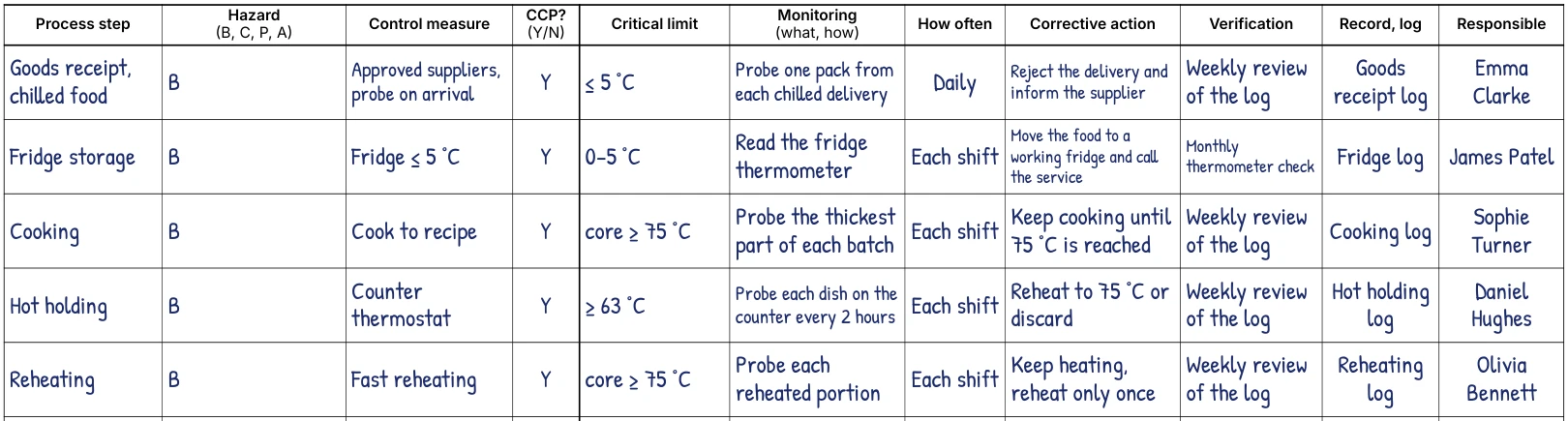
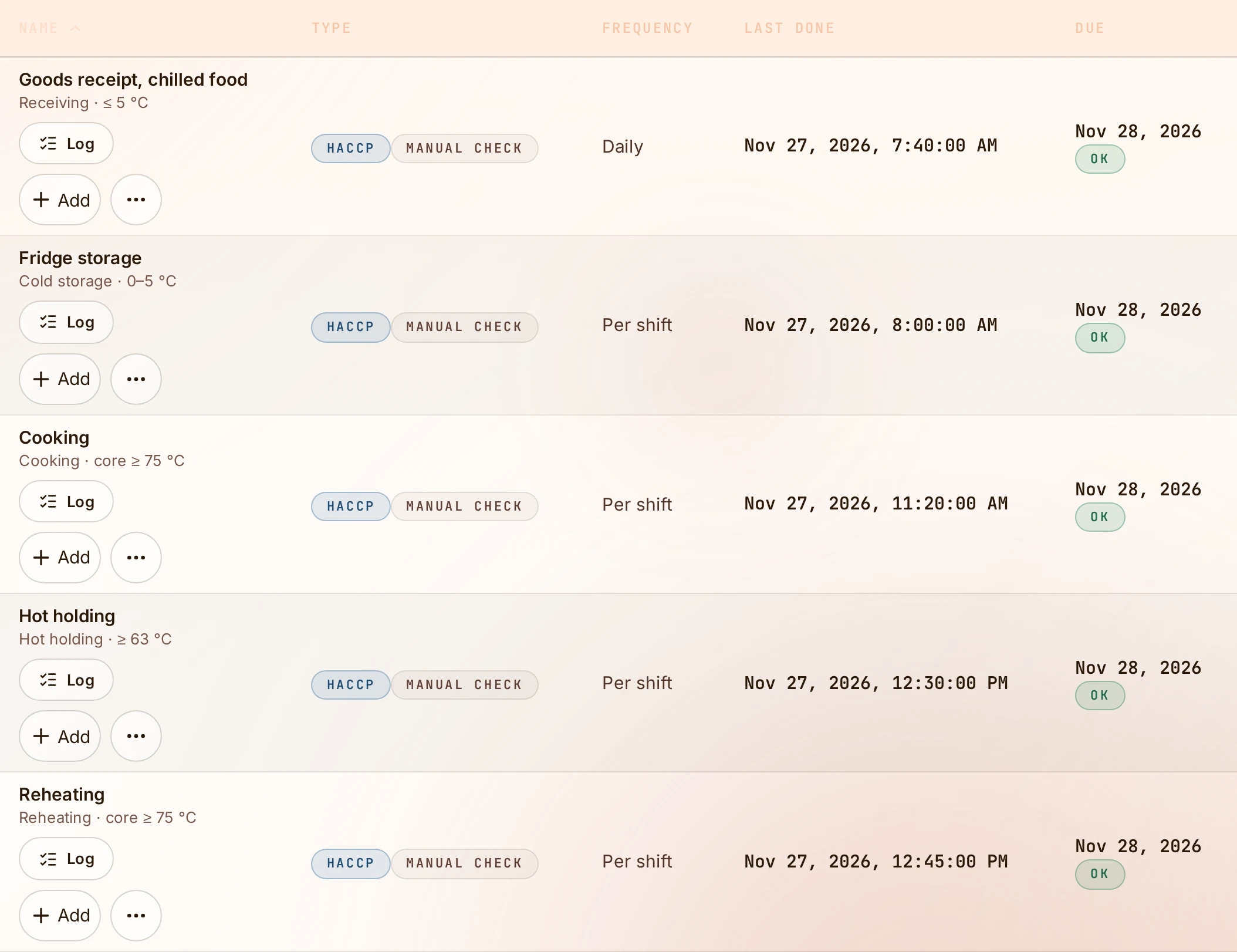
A HACCP plan is the written core of a kitchen’s food safety system: it names the hazard at each process step and how it is controlled. This free HACCP plan template is for restaurants, cafés, food trucks and small commercial kitchens that write or update their own plan. It has six sections on four landscape pages, following the seven HACCP principles: HACCP team, products and scope, prerequisite programmes, process flow, the hazard analysis and critical control point table, and verification and review, with the food business operator’s sign-off. The Record, log column links every critical control point to the daily log that proves it.
When and why to use it
Use it when you open a kitchen, add a menu group, change a process or equipment, or when an inspector or auditor asks for your plan. Article 5 requires a review after every change to a product, process or step. A review after an incident or a complaint shows whether the checks still work.
What the law requires
Scope: food businesses in the EU and Great Britain. Regulation (EC) No 852/2004, Article 5, requires a permanent procedure based on the seven HACCP principles, with documents and records that fit the nature and size of the business, and a review whenever a product, process or step changes; Great Britain keeps this article as retained law. The Food Standards Agency publishes Safer Food Better Business, a food safety management pack for small catering businesses. In the US, the FDA Food Code requires a submitted HACCP plan only for certain processes, such as reduced oxygen packaging or a variance (8-201.13); other rules come from your state or local authority.
EUR-Lex: Regulation (EC) No 852/2004 on the hygiene of foodstuffs · Food Standards Agency: Safer food, better business for caterers · FDA: Food Code 2022 · 2026-11-26
The plan must describe your own menu, processes and premises. A copied example plan does not show that your kitchen is under control.
How to fill it in, in 5 steps
- 1On page 1, fill in Business name, Address of the premises, Food business operator, HACCP team leader, Type of business, Plan version, Date of plan and Next review.
- 2In 1. HACCP team, list each member with role, food safety training and signature. In 2. Products and scope, write the menu groups and products, who eats the food and how it is served, and tick every process step you use.
- 3In 3. Prerequisite programmes, write for each of the 10 printed programmes where the written procedure is kept, which record or log proves it, who is responsible and when it was last reviewed.
- 4In 4. Process flow, write your steps in order. In 5. Hazard analysis and critical control points, give each step a row: hazard (B, C, P, A), control measure, CCP? (Y/N), and for every CCP the critical limit, monitoring, how often, corrective action, verification, record and responsible person.
- 5In 6. Verification and review, write each check of the plan with date, result and changes made. The food business operator signs and dates the plan; review it after every change to a product, process or step.
How it works day to day
- 1List each menu group and write its steps from delivery to service.
- 2For each step, write the hazard and decide whether the step is a critical control point.
- 3For each critical control point, set a measurable critical limit, the check, how often it is done and who does it.
- 4Name the log that records each check, for example the cooking or cooling log, and sign and date the plan.
Worked example
A café that serves soups and sandwiches writes Plan version 1 on 10 March 2026, with Next review 10 March 2027. In 2. Products and scope it ticks Receiving, Chilled storage, Preparing ready-to-eat food, Cooking, Cooling, Reheating and Hot holding. In 5. the Cooking row reads: hazard B, bacteria survive in soup; control measure, cook to a safe core temperature; CCP? Y; critical limit 75 °C in the core, the limit this café set; monitoring, probe the thickest part; how often, every batch; corrective action, keep cooking and probe again; verification, the manager reads the cooking log every Friday; record, cooking temperature log; responsible, the cook on shift. Chilled storage is not a CCP here: it is covered by the prerequisite programme Temperature control and thermometer checks and recorded in the fridge log.
Common mistakes
- Copying a sample plan without matching it to your own menu and equipment.
- Writing a limit that cannot be measured, such as ‘cook well’.
- Naming a check in the plan that nobody records in a daily log.
- Leaving the plan unchanged after a new dish, process or appliance.
Is this template a finished HACCP plan?
No. It gives the structure. The hazards, limits and checks come from your own processes; your local authority or food safety adviser can review them.
What does EZLineGo store for the plan?
The hygiene page keeps your own plans with control point, critical limit, check frequency, monitoring instructions, last check and next due date, and exports a plan PDF.
Do I need an account for the blank form?
No. The PDF and the editable file are free without registration. Saving records in the app requires an account and Pro access or an eligible 30-day Pro trial; no card is required for the trial.