When and why to use it
Use it for two to four weeks to find the biggest sources of waste, or keep it every day if you work on lowering food costs. It is most useful after a menu change, during a slow season, or when food costs rise without more sales.
Practical guidance
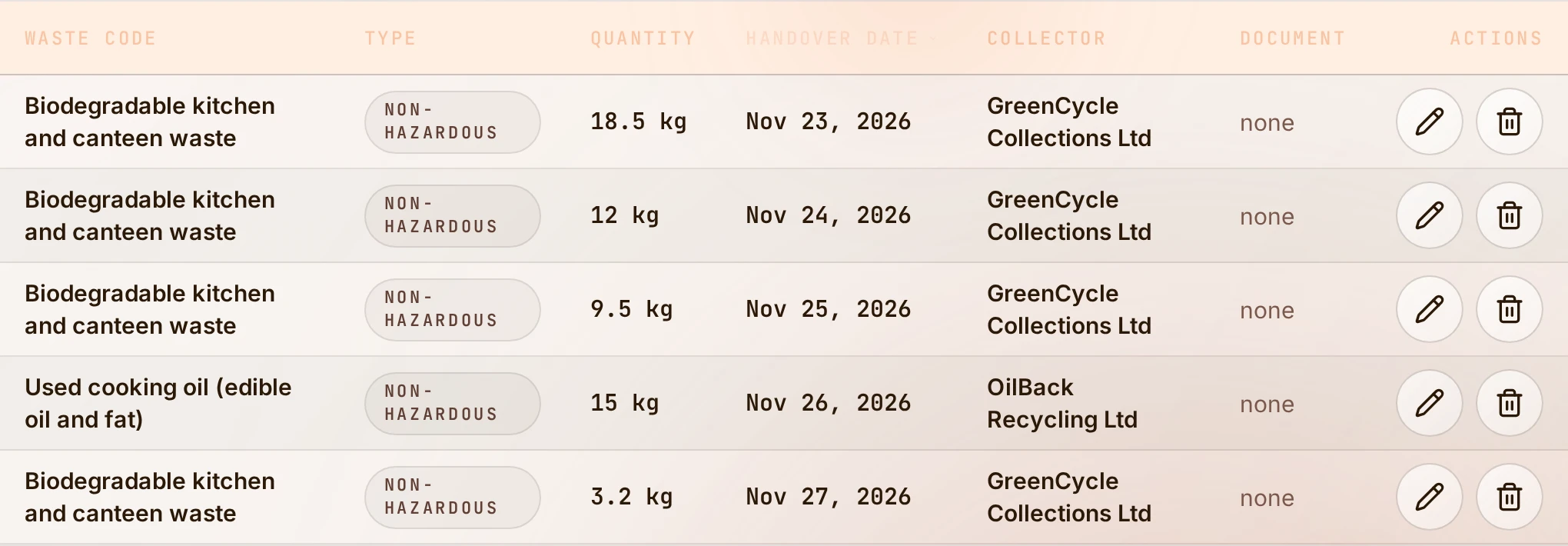
No regulation requires a food waste log for HACCP. Regulation (EC) No 852/2004, Annex II, Chapter VI, requires food waste to be removed from food rooms quickly, kept in closable containers and disposed of hygienically; that duty applies whether or not you log it. Waste handed to a collector, such as used cooking oil, is recorded under the waste rules of your country, which is a separate record. Use this log as a cost and planning tool: weigh at the point of disposal, use the same few reasons every time, and review the totals each week.
EUR-Lex: Regulation (EC) No 852/2004 on the hygiene of foodstuffs · US EPA: Food waste log (Food: Too Good to Waste) · 2026-11-26
Weigh or count the waste before it goes in the bin. Estimates written at the end of the day hide where the waste really comes from.
Worked example
Week beginning 9 March 2026 at a lunch café. Monday 15:20: Food item tomato soup, Reason O, Quantity 3, Unit l, Cost (estimated) 4.50, Where it went bin, Recorded by KB. Tuesday 09:05: croissants, Reason S, 6 portions, 3.00, donation. Wednesday 14:40: chicken salad, Reason P, 1.2 kg, 7.20, bin. Friday 10:15: lettuce trimmings, Reason T, 0.8 kg, 1.10, compost. The Week total is 15.80 in the café’s own currency; the soup and the salad cause most of it, so the café now makes soup in two smaller batches and plates salad in smaller portions with a free refill.